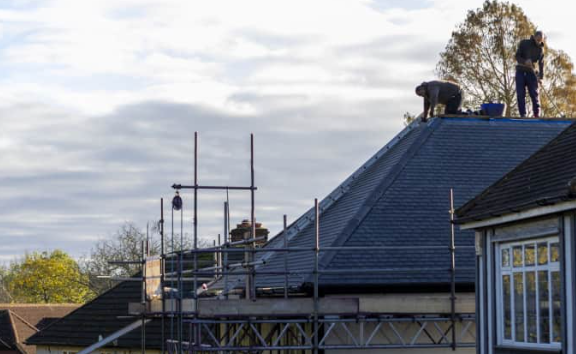
Twelve thousand dollars a year, every year, on a line item called roof repairs. By the fifth spring most yard managers stop calling that maintenance and start asking around for the best roofing company MA facility crews actually keep on file. The patching itself is not the failure. The failure is that patching became a budget decision nobody ever made on purpose, renewed each March by default because the alternative was never priced against it.
Roof money behaves differently from the rest of the maintenance budget, because what you are buying is years rather than repairs. A June 2026 cost breakdown from This Old House puts installed metal roofing at $13 to $45 per square foot against a 40 to 70 year service life, which is the entire argument compressed into one line: the sticker is high and the cost per year is low. Patching inverts that math. You pay a small number often, indefinitely, and nothing about the payment schedule is yours to set.
Five Springs of Patching Outspent One Replacement
The case we keep running into is a 40,000 square foot warehouse with a dock canopy, a couple of old curbs, and one seam that opens in the same place every thaw. Nobody replaces a roof over one seam, so the seam gets sealed, and the invoice is small enough to approve without a conversation. Five of those invoices, plus two emergency call-outs at holiday rates, and the section over the docks has quietly cost more than tearing it off would have. The roof does not care about your fiscal calendar.
See also: Advanced Component Repair Services: Extending the Life and Performance of Critical Turbine Equipment
Freight Damage Never Shows in the Roof Line
Water that lands on palletized freight gets written off somewhere else. It shows up as damaged cartons, a short-paid invoice, a customer credit, or an hour of forklift time spent shuffling pallets out from under a drip on a Saturday. None of it is coded to the building, so the roof looks cheaper on paper than it actually is. Before anyone argues about replacement, pull six months of damage claims and mark the ones that happened within twenty feet of a known leak.
Run the Patch Versus Staged Replacement Numbers
Staging means replacing the roof in sections over two or three budget years instead of shutting the yard down for one enormous project. It also means the worst section goes first, which is usually the one over the docks, where the traffic and the freight both are. A contractor who inspects, photographs, and cores the assembly can tell you which sections have wet insulation and which ones have another five years in them, and that document is what turns a guess into a capital request.
Run it on the dock bay alone. Say the 40,000 square foot roof carries a $12,000 annual patch line, and roughly $7,500 of that lands on the 8,000 square feet over the docks. Add the freight nobody claims, call it $4,200 a year in damaged cartons and customer credits, and that one section is costing about $11,700 a year before you count the labor of moving pallets around a bucket. Five springs of that comes to $58,500. Tearing off and replacing the same 8,000 square feet with a new membrane at roughly $8.50 a foot runs you $68,000 all in, and across a twenty year assembly the annual cost works out to $3,400. Those are illustrative numbers, not a quote, but the shape holds on most yards this size.
If the Same Seam Fails Twice Stop Patching
Here is the rule of thumb worth remembering. If the same seam or the same curb fails twice inside eighteen months, stop buying patches on it and price the section, because the substrate underneath is almost certainly wet. If it is a different spot each spring, keep patching, keep the log, and re-inspect in the fall. Wet insulation does not dry out under a new patch, it spreads, and a crew that keeps sealing over it is selling you the same repair on a longer schedule.
Put the Roof Into the Capital Plan
A roof that lives in the repair budget will always lose to a forklift lease or a dock leveler, because repairs get approved and capital gets scrutinized. Move it: get a documented inspection with photos and moisture readings, a section-by-section condition rating, and a phased scope with a price on each phase. That packet is what a finance director can actually act on, and it is why the shortlist for the best roofing company MA operators trust should be built in October, not during a February leak. Patching is a decision, same as replacing, and the only real difference is whether you made it or the weather did.
